
Compositing techniques?
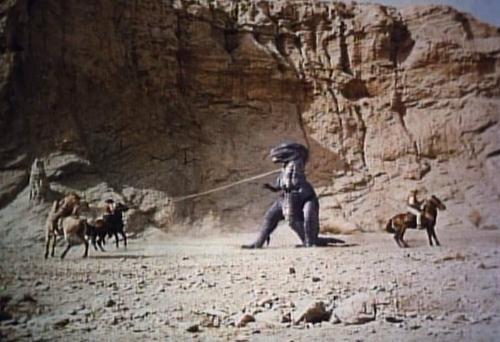
According to my tutor, the animator most likely had the live action projected on to a screen and the animator then moved the dinosaur models on 12 fps. When I heard this I realised this had an uncanny resemblance to MayaLive and animating in Maya- We set up a camera and plane, project our film through the camera on to a plane by selecting an image sequence. We then use MayaLive to track, import the necessary model/rig. I would then place my dinosaur rig in to position and then start animating, blocking out my animation based on my storyboards and then smoothing out my animation.
I was able to watch a film trailer for The Valley of Gwangi on YouTube, and I was amazed at the quality of the animation- slow in slow out, the movement and follow through of the tail and this was done well before computer animation, and I still struggle with these principles of animation on a computer. So I found this astounding.
Notes from Special Features section of The Valley of Gwangi DVD.
Harryhausan imbued personality in to these puppet characters- this is one of my objectives as I want to add a playful dog personality
Subtlty to the characters that make Ray Harryha
Subtly to the characters that make Ray Harryhausen unique- like I have written above, these subtleties that we don't notice if they're there and we just perceive this as natural movement but we notice it when it isn't done properly I find amazing at how this was pulled off without so many of the digital tools that we have today.
Everyframe had to line up the rope (in trying the capture the dinosaur scene) frame by frame. (See picture above).
The Good, The Bad and The Ugly.
What lighting did they use in the film?
I watched the special features to this DVD but it only elaborated on Sergio Leone's style. Which I knew already as it was very evident in the film, so evident that I was dosing off because I'm so used to action, and something happening. Watching The Good The Bad and The Ugly made me realise that film has evolved over the decades.
"Restoring 'The Good The Bad and The Ugly'"
Techniscope- obsolete format. Very difficult to convert. Depth of field was better on this format and it was cheaper. The conversion process was not automatic it all had to be done by eye.
As a lot of the shots both in the feature film and in the shots that I had chosen were outside I think a majority of lights came from natural light and some extra lights were added in, in order to prevent shadows from appearing.
Sergio Leone based a lot of his compositions on paintings. So The Good The Bad and The Ugly was based on portraiture.
